
◆ Headlight Restoration
Why Are My Headlights Cloudy? (And How to Fix It)
By Brandon · Onyx Pristine Co. · Cincinnati, OH ·
◆ Quick Answer
Headlights turn cloudy because the factory UV coating on the polycarbonate lens breaks down from sun exposure, letting the plastic underneath oxidize. Toothpaste and drugstore kits can buff away the haze temporarily, but without resealing the surface it comes right back — often in weeks. A professional restoration removes the damaged layer and reseals it with a UV-blocking coating, which is why it actually lasts. Onyx Pristine Co. does this mobile, at your driveway, for $80 for both headlights.
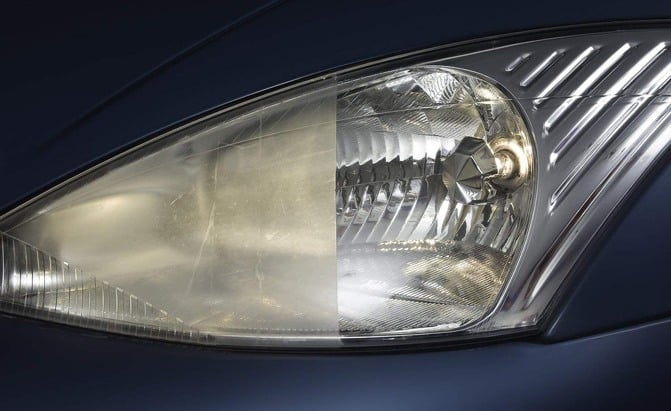
If you've noticed your headlights look yellow, foggy, or just dimmer than they used to be, you're not imagining it — and you're not alone. It's one of the most common things we get asked about on the road. It also isn't just a cosmetic issue. Cloudy lenses genuinely cut down how much light reaches the road in front of you, which matters a lot once the sun goes down or the roads get wet.
The good news: it's almost always fixable, and it's rarely the headlight itself that's the problem. Here's what's actually happening, why the drugstore fixes don't hold up, and what actually works.
Why Headlights Turn Yellow and Cloudy
Modern headlight lenses aren't glass — they're polycarbonate plastic. It's lightweight, impact-resistant, and easy to mold into the sharp shapes on today's cars. The tradeoff is that raw polycarbonate isn't naturally UV-stable, so every headlight leaves the factory with a clear protective coating baked onto the outside of the lens.
That coating is doing all the work. Over years of sun exposure, heat, and road chemicals, it slowly breaks down. Once it's compromised, UV rays reach the polycarbonate underneath directly, and the plastic starts to oxidize — the same basic chemistry as rust on metal, just happening to plastic instead. That oxidation is what shows up as yellowing and haze.
A few things speed this up:
- Direct sun exposure — cars that live outside or park facing south/west cloud up faster than garaged vehicles
- Heat cycling — the constant heat-up/cool-down near the engine bay stresses the coating
- Road grime and chemicals — brake dust, exhaust, and winter road salt accelerate the breakdown
- Age — most factory coatings are only rated for 5–7 years before they start to fail
The important part: the damage is almost always on the outside surface of the lens, not inside it. That's exactly why restoration works — we're not trying to clean through the plastic, we're removing a thin damaged layer and putting a fresh, UV-stable surface back on top of it.
Why Toothpaste and DIY Kits Don't Last
Toothpaste, bug spray, drugstore polish kits — there's no shortage of "hacks" floating around for this. And to be fair, most of them do something. Toothpaste is a mild abrasive, so rubbing it on a hazy lens can knock down some of the surface oxidation and make things look a little clearer for a bit.
The problem is what happens after. None of those methods put any UV protection back on the lens. You've just exposed slightly fresher plastic to the sun with nothing shielding it — so the clock starts over immediately, and most people see the haze creeping back within a few weeks to a couple of months. It's a temporary patch, not a fix.
Cheap headlight restoration kits from an auto parts store go a step further with real sandpaper and a small polish, which is closer to the right idea. But most of them still skip (or include a weak) UV sealant step, and without a machine to work the polish evenly, it's easy to leave the lens hazier in some spots than others. You'll get a better result than toothpaste, but it's still a short-term win in most cases.
What Actually Works: The Professional Process
A real restoration isn't complicated, but it does need the right tools and the right order of operations. Here's what we do on every job:
- Mask and prep — the surrounding paint and trim get taped off so nothing around the headlight gets touched by the sanding or polishing step
- Wet-sand — we work through multiple sandpaper grits to remove the UV-damaged layer, scratches, and oxidation down to clear, undamaged polycarbonate
- Machine polish — using professional-grade forced-rotation DA (dual-action) polishers and Koch Chemie compound, we bring the lens back to a mirror-clear finish and remove every trace of the sanding marks
- Ceramic UV sealant — a professional-grade UV-blocking ceramic coating goes on last, locking in the clarity and protecting the fresh surface from the sun. This step is what separates a restoration that lasts years from one that lasts weeks
The whole process takes under an hour for both headlights, and because we're a fully mobile operation, we do it right in your driveway. No dropping the car off, no rental car, no waiting room.
The Real Cost Comparison
A lot of people assume cloudy headlights mean a trip to the dealer for new housings. That's rarely necessary, and it's a lot more expensive.
- OEM replacement headlight assemblies typically run $200–$600+ per side for the part alone, before installation labor
- Aftermarket assemblies are cheaper upfront, but often ship with weaker UV coatings that yellow again within a couple of years — putting you right back where you started
- Professional restoration is $80 for both headlights, done in under an hour, with results that hold for 2–3 years
Unless the housing itself is cracked, has moisture trapped inside, or there's damage to the reflector or projector behind the lens, restoration gets you the same result as replacement — factory-clear headlights — for a fraction of the cost. Most of our clients treat it as routine maintenance every couple of years rather than a one-time repair, which keeps the total cost over the life of the car far below what a single replacement would run.
Frequently Asked Questions
Can I fix cloudy headlights myself? You can improve them temporarily with a DIY kit or toothpaste, but without wet-sanding down to clear plastic and sealing it afterward, the haze typically returns within weeks. A professional restoration removes the damaged layer and protects the new surface, which is why it lasts.
How much does professional headlight restoration cost? We charge $80 for both headlights, done mobile at your driveway in under an hour.
How long does it last? With the ceramic UV sealant we apply, results typically hold for 2–3 years, depending on how much direct sun the car gets.
Is this just cosmetic, or does it actually matter? Both. Severely oxidized lenses can cut light output by 50–80%, which is a real difference in visibility at night and in bad weather — not just a cosmetic upgrade.
Curious how the restoration compares to a full replacement in more detail? See our Headlight Restoration vs. Replacement breakdown.
Book Mobile Headlight Restoration in the 513
$80 for both headlights. Under an hour. We come to your driveway — open 7 days a week, 7am–10pm.